Taxpayer Burdens and the "Best States for Business"
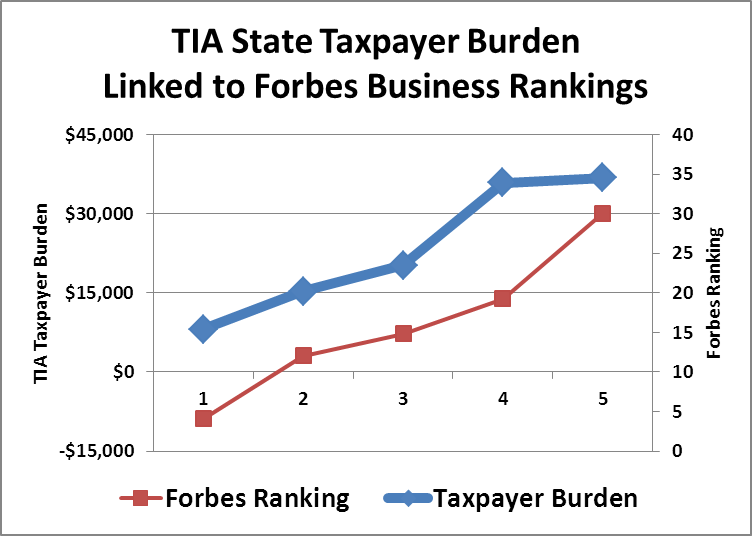
Forbes magazine released its annual “Best States for Business” rankings last week. The Forbes rankings share a relationship with Truth in Accounting’s (TIA) “Taxpayer Burden” measure of state debt loads. As a general rule, the higher the Taxpayer Burden, the worse the “Best State for Business” ranking.
The chart above puts the 50 states in 5 groups, based on their TIA Taxpayer Burden. The states are ranked from lowest to highest on their Taxpayer Burden. The ten states with the lowest taxpayer burden are in Bucket Number 1 above, and the ten states with the highest taxpayer burden are in Bucket Number 5.
In turn, the chart also shows the average ranking for each group of ten states on the Forbes “Best State for Business” study. The states with the lowest taxpayer burdens are also the states with the best ranks on business-friendliness, and vice versa.
Here are the ten states with the highest TIA Taxpayer Burdens:
|
West Virginia |
$18,600 |
|
New York |
19,800 |
|
California |
22,100 |
|
Michigan |
25,300 |
|
Massachusetts |
25,500 |
|
Kentucky |
26,700 |
|
New Jersey |
34,200 |
|
Hawaii |
39,900 |
|
Illinois |
42,200 |
|
Connecticut |
46,000 |
On the other hand, here are the ten states with the lowest TIA Taxpayer Burdens:
|
Alaska |
-45,000 |
|
Wyoming |
-23,500 |
|
North Dakota |
-16,100 |
|
Utah |
-2,500 |
|
Nebraska |
-2,000 |
|
South Dakota |
-1,700 |
|
Tennessee |
-300 |
|
Iowa |
-100 |
|
Montana |
1,000 |
|
Oregon |
1,300 |
State government financial conditions are only one element of overall state business-friendliness, of course. Yet many of the same factors responsible for determining the Taxpayer Burden are also associated with a state’s business environment and its economic growth.
You can investigate trends in Taxpayer Burdens, the ranking on the Forbes “Best States for Business” study, and many other metrics with our Charting Tool at State Data Lab.