
Hawaii
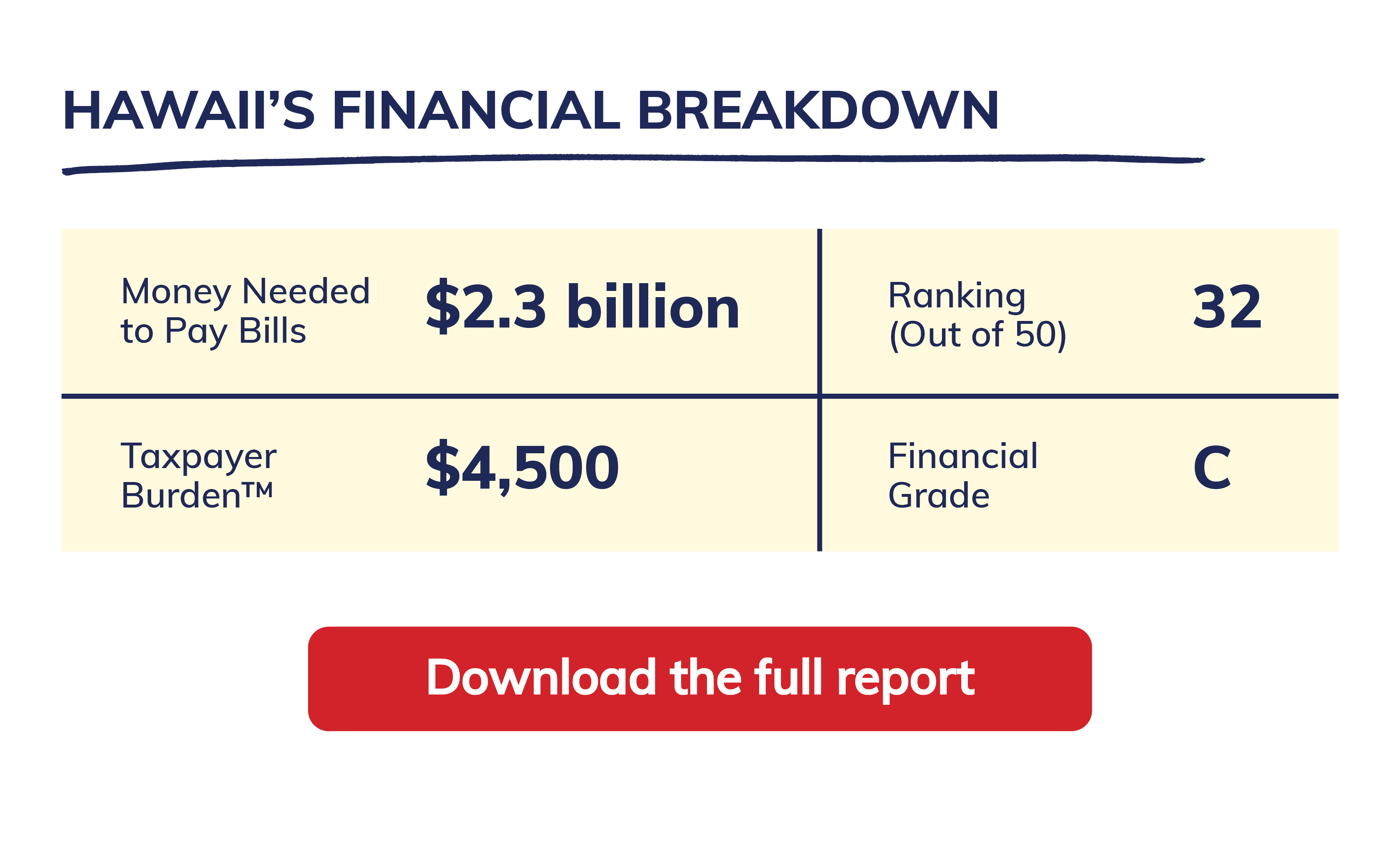
| Hawaii owes more than it owns. |
| Hawaii has a -$4,500 Taxpayer Burden.™ |
| Hawaii is a Sinkhole State without enough assets to cover its debt. |
| Elected officials have created a Taxpayer Burden™, which is each taxpayer's share of state bills after its available assets have been tapped. |
| TIA's Taxpayer Burden™ measurement incorporates both assets and liabilities, not just pension debt. |
| Hawaii only has $19.4 billion of assets available to pay bills totaling $21.7 billion. |
| Because Hawaii doesn't have enough money to pay its bills, it has a -$2.3 billion financial hole. To fill it, each Hawaii taxpayer would have to send -$4,500 to the state. |
| Hawaii's reported net position is overstated by $620.4 million, largely because the state delays recognizing losses incurred when the net pension liability increases. |
| The state's financial report was released 214 days after its fiscal year end, which is considered untimely according to the 180 day standard. |
Prior Years' TIA Reports
2024 Financial State of Hawaii
2023 Financial State of Hawaii
2022 Financial State of Hawaii
2021 Financial State of Hawaii
2020 Financial State of Hawaii
2019 Financial State of Hawaii
2018 Financial State of Hawaii
2017 Financial State of Hawaii
2016 Financial State of Hawaii
2015 Financial State of Hawaii
2014 Financial State of Hawaii
2013 Financial State of Hawaii
2012 Financial State of Hawaii
2011 Financial State of Hawaii
City and Municipal Reports
Other Resources
Hawaii Annual Comprehensive Financial Reports
Publishing Entity: Department of Accounting and General Services
